Monday, August 22, 2016

How Much Does It Cost To Pass A Combine?


Below is a breakdown of the total (fiscal) cost incurred to develop myself to the point of passing a Combine.

Things to note as you read through the data:

* Figures in bold that aren't underlined represent the monthly fee for the Combine- commas separate the months. E.g Two bold, non-underlined figures means the Combine lasted at least two months.

* Figures in bold that ARE underlined represent "account resets"- where rules were broken/limits were surpassed and the account was reset.

* The (mostly negative) figures after the backslash is the amount of profit/loss shown on each Combine account when it was closed/reset.

* Some Combines were paid for with "Ticks"- TST's currency that was paid out to people who participated in the "Community Journal" and in the "Squawk" chat room. (They've stopped offering Combines for ticks now).

* The monthly fee varies as I changed account size.

* Finally, the total cost is shown at the end in bold along with the total P&L of all the accounts...shown after the backslash.

-----------------------------------------------------------------------------------------

CREDIT CARD TRANSACTION FEES NOT INCLUDED!

1) 20-DAY Combine. Completed 09/07/14= ??? (~$300) (NO RECORDS) /-$5370

2) Combine. Completed 31/03/15= $279, $279, $100/ -$3280

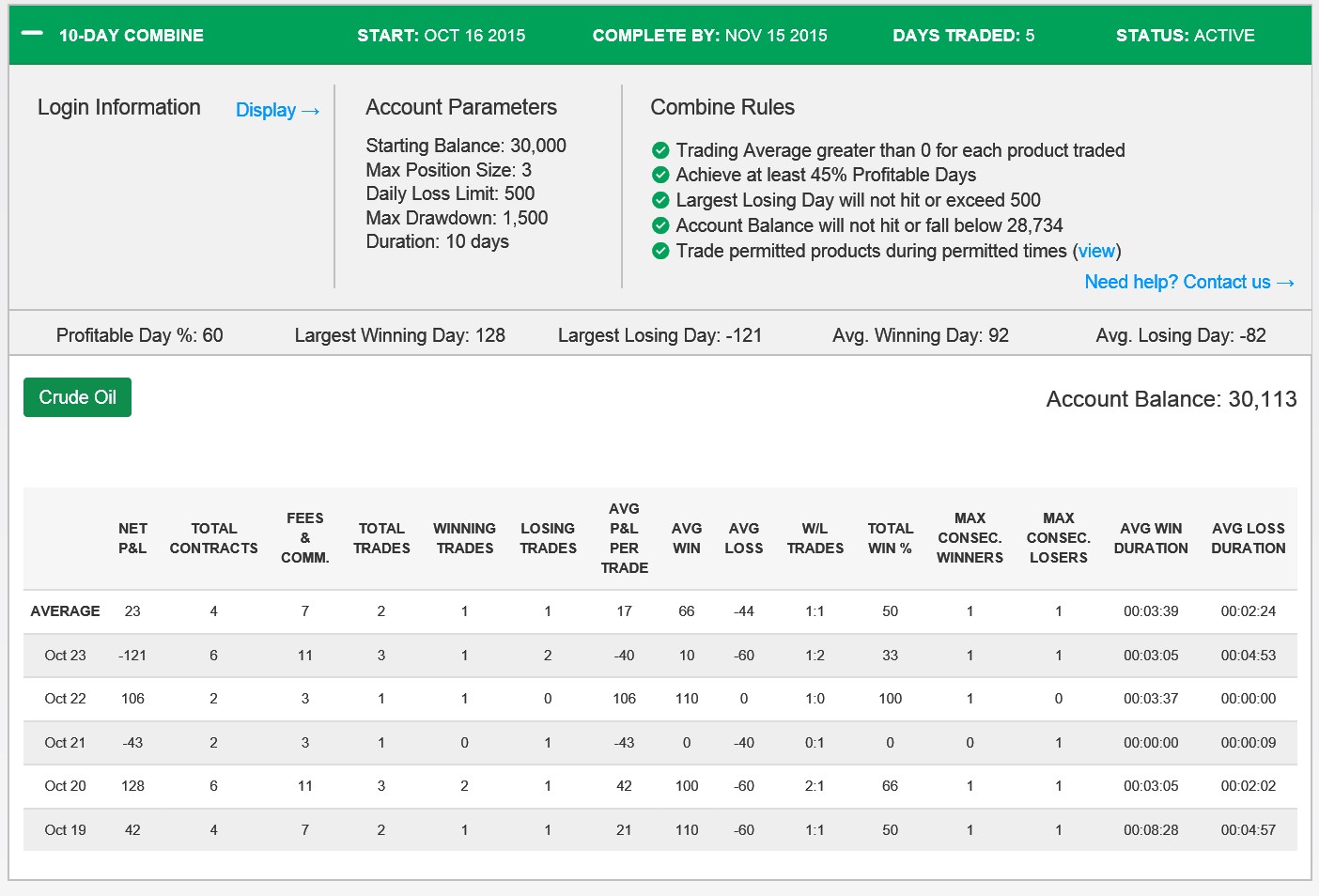
3) 10-DAY Combine. Completed 18/05/15= $FREE (Ticks)/ +$552

4) Combine. Completed 13/05/15= $325/ -$2801

5) Combine. Completed 15/06/15= $150, $100/ -$1548

6) 10-DAY Combine. Completed 15/06/15= $FREE (Ticks)/ -$1594

7) 10-DAY Combine. Completed 23/07/15= $FREE (Ticks)/ -$288

8) Combine. Completed 24/08/15= $150, $150/ -$272

9) 10-DAY Combine. Completed 11/09/15= $FREE (Ticks)/ -$137

10) Combine. Completed 01/10/15= $150, $100/ -$1513

11) 10-DAY Combine. Completed 30/10/15= $FREE (Ticks)/ +$294

12) Combine. Completed 31/10/15= $150, $100/ -$1184

13) Combine. Completed 20/11/15= $150, $100/ -$1510

14) Combine. Completed 11/03/16= $150, $150, $150/ -$1133

15) (Combine. Completed 30/05/16= $100, $100, $100- Patient Pigeon Account.)/ -$240

16) Combine. PASSED 20/08/16= $150, $150, $150/ +1508


TOTAL COST: $3783/ -18,516


PS

For those who want to follow my Equity Curve journey, that post is in the "featured post" section at the top right of the blog. This will save having to scroll back to find it :)

Friday, August 19, 2016

Combine PASSED!


After 2 years and many attempts, I've finally managed to pass TopstepTrader's $30K Combine!


The entire Combine lasted 57 trading days and 260 trades were taken. The vast majority of these trades were made across 4 instruments: 6A (Aus/Usd futures), 6B (Gbp/Usd), 6C (Cad/Usd) and YM (Dow Jones). 5 trades were taken in the ES (S&Ps) and 1 lone trade in CL (Crude futures).

A tightened up the strategy by making things more statistical and objective using the lessons learned  that I covered in this post. This change occurred 9 days into the Combine and is what I consider the beginning of orderly, rules-based trading within the entire data set.

The results after statistics were applied to the method.

The hardest part of achieving this result was giving up control. I used various techniques to help manage myself along the way, which I'll talk about in a future post.The range of emotions experienced were sometimes very hard to deal with, especially given the numerous stressors that have been present in my life over the last 12-18 months or so (births, deaths, financial difficulties, health and relationship...the list goes on and on).

I also met internal resistance when I reached the $1K mark and, then, when the finish line was in sight.

Next up: A post detailing the cost incurred to get to this point in my TST trading journey. Stay tuned :).

Wednesday, August 17, 2016

Running P&L In R

Keeping what I said regarding showing vs being firmly in mind, I've decided to share my running P&L with the trading blogosphere!


I've converted the chart from $$$ to risk units - this allows me to share the journey without the potential pressure of sharing the actual dollar gains/losses. Having said that, the usual caveat applies - if it messes with my ability to trade properly, it'll be gone quicker than cake at a Weight Watchers meeting!!

Reasons for doing this:

1)  During the years of following trading blogs, I only know of two that have consistently posted their P&L without conveniently skipping out periods of time (where anything could have happened!). This one  does so in points, while this one does so with $$$ and accompanying charts. I want to add an element of credibility to my posts so that people can verify how well the principles, spoken about in this blog, translate into real-world results.

2)  It's taken me a long time to begin to understand the nature of probability, variance etc. and how we need to fully understand our expectancy, the journey it can take us on, and adjust our expectations to be able to accept the journey without destroying the long-term edge. This curve will serve as a reminder for me when things look grim and as a reference for any future posts.

NOTE!: Friday 23rd September's result is not accurate as much bigger risks were taken to achieve the ~ -3R result in order to try to get above $0 in order to satisfy an FTP rule. I've normalized the result in order to not skew the curve but the result in actual risk taken would have been closer to zero.

Thursday, August 11, 2016

10-Year Trading Anniversary: What Has A Decade In The Markets Taught Me?

Today marks 10 years to the day that I set off on my journey into trading the markets by attending Day 1 of a 3-Day seminar.

It's also my birthday! I don't remember whether or not I had intentionally chosen that date to attend the course, but it's a cool bit of trivia that my trading anniversary coincides with my birthday....but I digress...

The course I attended introduced me to the basics (for a hefty price!) and touched on the psychological aspects of trading. The real learning began years later as I found myself trading a $50K account, of money I had borrowed from a bank, whilst trying to regain my composure after my first (8 trade) losing streak...

So, what has a decade of playing this crazy game taught me? 


I've Found The Holy Grail!! 

There is no technical holy grail... every system, approach and method will draw down. Oftentimes more than you'd expect. If ever there was a "holy grail", it'd be the ability to weather the storm until the method eventually picks up again- even after a 17-trade losing streak ;).

Embrace Losers

Let's pretend walking represented a positive trading edge. If the left leg represents losers and the right one represents winners, how far would you expect to get trying to walk on just the one (right) leg?? This is where being truthful with yourself comes in...the goal is to execute a process, with it's inherent losers, not reach for a certain positive outcome/run away from a negative outcome.

A good exercise for checking your resistance toward following a process rather than seeking an outcome is to take note of the thoughts running through your mind when you review some of your trades. If you start blaming yourself for the inevitable times where you are stopped to the tick, or you start looking for a way you could have exited sooner before giving back that 2R paper profit even though the method said that's what you should do...there is still mental progress to be made.

Let Go Of Control

We control nothing but our thoughts and our actions. I've lost count of the amount of times I've sat watching a trade, sometimes for hours, before falling into bed or going out for some much needed air and/or exercise. As if watching it made the difference. The "illusion of control" is one of the more costly cognitive biases as it expends our energy, completely in vain.

Mind The Gap!

I've written about this several times on the blog. Essentially, if we are able to take action at any moment during a trade, then we have no live edge. Every living thing/system relies on gaps to exist. This means we have to let go of control and have faith and trust in our plan over the long-term, almost ignoring what happens in the short-term.


------------------------------------------------------------------------------------


In a nutshell, I've learnt that we have to be comfortably uncomfortable in order to make progress. Growth hurts, no pain no gain etc.

 I've focused on the trading aspects in this post but, truth be told, learning how to trade has influenced my life- the way I think and live- far more than it has my actual trading. Almost as if trading were a metaphor for life...

Sunday, August 7, 2016

Trading Update + Lessons Learned

A lot has changed in the last five months.

In my last post, I mentioned the importance to me of letting go of ownership and the urge to show rather than be. The ramifications of thinking we own anything are huge, both in trading and in life, and I've touched on this subject a few times in this blog, such as here and here.

Remember the Momo? The pattern I've devoted some 8 years of my life to since the inception of this blog??
8 years of charts and notes devoted to the Momo- I have literally gigabytes of video reviews on HD too!
Well, I've let all of that go and completely changed my methodology.

Just because we are victims of the sunk cost effect, doesn't mean we have to continue to be victims! Letting go of the need to be the one in the driving seat (when I helped my partner with her Combine) allowed me to see things from a much more neutral perspective. I've now carried that perspective over to my actions, even when doing things "for me" or with things that "I own".

I'm no longer trying to scalp on a 15 sec chart (for the first time in years). I now use a 5 min. No more fear of trading in harmony with a larger chart. I now trust in the direction of the larger chart, even though I know that the trust will be frequently broken.

No trailing. No break-even trades. No tiny R:R trades.Gone are the days where I only trade 1 market....I now watch 4 markets and trade up to 3 of them at any given time....Not only have I let go of the method I invested so much time, effort and money in, I've pretty much changed every facet of my general approach to trading.


LESSONS LEARNED:

1) Large(r) stops and targets are best- I did a video on why here.

2) Trade with "If/Then" statements- Rather than "we'll see". Base these statements off of something you can quantify (objectively) not qualify (subjectively).

3) Be specific- "I'll buy near that support when I see a reversal candlestick" isn't enough. How do you define "near"? What exactly is a "reversal candlestick"?


Friday, February 26, 2016

End Of Crude Combine- Break-even, Complexity & Showing Vs Being.

I've taken away a HUGE amount of information from my experience in this 3-month-long Combine. I will attempt to reduce the information in this post down to its core principles/points... that way it will be easier for me to cull information from it as needed when the inevitable need for new direction arises.

Here is a screenshot of the TST report:

I have more faith than ever in the method as holding break-even for 3 months/1 financial quarter is not to be sniffed at. Novice traders will look at how much you didn't make, experienced traders will look at how much you didn't lose...

Result up until 19th Feb....3-months to the day.


Random- truly random- entries with a fixed stop/target would result in a loss of costs per trade turned (spread + commissions...slippage negates itself as there is +ve as well as -ve slippage throughout). Therefore: 129 trades with a spread of $10 and a commission of $3.68= -$1764.72. Put another way, you have to have an edge of 1.368 cents per trade to cover costs. Anything above that goes in your pocket.

Simplicity= The initial $800 run-up- key stats:

- 20 trades over 12 traded days out of a possible 19 trading days.
- 50% WR (10 trades. All +10 cents or greater), 30% LR (6 trades. -6 cents), 20% BE (4 trades). 
-No trailing.
-1 pattern, 1 time frame, lots of patience.

Complexity= The second, $770 rally after fall due to "Showing" (more on that later):


-11 trades over 5 traded days out of a possible 5 trading days.
-45% WR (5 trades. 4 >/= +15 cents...1= +11 cents) 19% LR (2 trades. -6 cents), 36% BE (4 trades).
-Some trailing.
-1 pattern, 2 time frames, less patience (but more giving back).

Objectively speaking, the complex approach yields more. $144 per trading day over $42 per trading day using the simple approach. But there are so many moving parts that it becomes even more dangerous to implement should emotion creep in to the process.

The lure was the higher profitability. But you really don't need to do better than $750/800 per contract per calendar month to make big things happen. Leaving $1K as a draw-down per contract, you'd be able to double your contract load every 1.25 months. Meaning a hypothetical 8 contracts after 5 months of compounding and a nice $6-6.4K/month.

Showing-

Green arrows show aforementioned run-ups in equity.
Ownership leads to showing. I had already figured this out back in mid 2012 when I managed this after a prolonged period of not talking specifically about trading results only to end up here

In the year that I took off from blogging between mid '13 and mid '14, I managed to put in Combine-passing performances (for the current rules) twice... back then, they were a lot more strict in terms of rules and didn't have the Continuous Combine, hence the reason why I didn't make it back then. 

The above evidence is clear. Sharing my results is bad for my trading health.

Moving Forwards:

1) No more Combines on my own for the foreseeable future. Instead, I'll work on doing one with my partner as we have shown consistently good results together.

2) No more 5 min chart. One target based off of the pattern and it's location within the backdrop as viewed on the one time frame (15 sec). Simplicity with patience.

I'll also be cultivating that distance from telling the story and, so, will make the following changes:

3) Stop writing a trading journal and capturing charts- It hasn't offered me any new information in a long-time and isn't where the issue lies.

4) Use what's working to help the trading plan evolve without having anything written in stone.

5) No more blogging- it just isn't serving me right now.


Monday, January 11, 2016

Crude Combine Update + LIVE trading video!

Decided to flip on Camtasia for the last two sessions last week.

This video shows my post trade commentary as the trades run at 4X normal playback speed. I also go through some stats in addition to areas of improvement.

Saturday, December 5, 2015

The Donkey, Carrot + The Edge Of Your Edge.

Like the Flintstones post cautioned, we need to be aware of the fact that the more nuts and bolts we have, i.e. facets of a trading approach, the larger the potential for weakness within said approach. In professional kitchen lingo, those "nuts and bolts" would be the "critical control points" under HACCP.

The fewer we have, the better our chances are of managing them correctly. Therefore, it makes sense to find out what we actually need to make a system effective and ditch everything else.... But not anymore than that.


So we need to find out where the "edge of the edge" is...the point at which removing anymore from the approach causes it to fall apart. Then take a step back. Only then will we be able to do the real work of executing flawlessly (or as close to flawless as we can get) without hiding behind the unnecessary complexity of things which don't add value.

Sometimes the hardest working people are the laziest :).

Of course staying as close to the edge of the edge without surpassing it is key too. Technically it's easy to do...the challenge is mental as we are forever destined to be the donkey who can't get the carrot, but continues to travel great distances. Achilles who can never catch the Tortoise no matter how fast he runs....

Can you make long-term profitable decisions without an anchor chart? Maybe you don't even need charts altogether..? Do you need to trail stops? etc. etc. Get rid of what isn't necessary...execute what IS necessary with greater precision.

Monday, November 30, 2015

The Golden Mean!


The Golden Key - a video by Jonathan Quintin Art
The Golden Key - a video by Jonathan Quintin ArtPhi: 1.618 is the ratio the universe uses to multiply and divide itself at all scales...Explore the connected universe in an interactive online learning community with Nassim Haramein, the Academy faculty and participants from around the world: The Resonance Academy –> http://bit.ly/getconnected-fb2The Delegate level 1 Course: Exploring Unified Physics is a comprehensive, self-paced online multimedia course packed with 30 years of research and the latest information on this topic. This material can literally transform the way you look at the world as it helps you to better understand our universe. Come join the thousands of people who are engaging with each other and our progressive faculty team in this co-creative learning community. Registration are open.The Resonance Project • The Resonance Project - Página Oficial Hispana • The Resonance Project - Traduction Française • The Resonance Project - Polska 8 The connected universe • The Resonance Project 共振企劃 • פרוייקט תהודה - The Resonance Project • (post by Jamie Janover)
Posted by Nassim Haramein on Monday, 2 November 2015

Saturday, October 31, 2015

Combine Update- CL going forward.


So despite getting excited about CL's newfound volatility, which started on Tuesday 27th, and impatiently rushing in to try to capitalise on it- hitting 11 losers in-a-row over the next two sessions- I eventually managed to ground myself and finish the 10-Day Combine at an equity high.

CL is definitely where I need to be.

The R:R structure mentioned in the prior post is something that will probably be dependant on the current market environment. As I found out over Tuesday/first half of Wednesday, it can be hard to shift gears...but it can be done. Of course, whether it's actually worth it will depend on how quickly you can adapt to the change and how long the change lasts for. For some, it might be better to stick with one model and see it through those periods where you feel as if you're swimming against the tide (using smaller R:R with higher WR in an expansive, trendy environment or larger R:R with lower WR in a range bound, choppy environment).

I also need to watch out for insisting on a certain scenario... the losing streak mentioned above was caused by two separate occasions where I wouldn't let go of a bias. A combination of trying to show the market that I wouldn't let it leave me behind (I know...not smart) and fear of missing out on the move.

I feel as if I'm ready to try my first C. Combine with CL as my instrument of choice. Something to think about over the weekend.

Sunday, October 25, 2015

Combine Update- Same Method, Same R:R, Different Instrument.


Some time ago, I noticed that a lot of TST traders that went on to be funded had two things in common. 1) The used a $30K and 2) They did it with CL.
 
Their daily WR was consistently higher than traders using other instruments, with many of them achieving 100% winning days. Those who achieved, say, 80-90% did so with larger winning days as compared to their losing ones.
 
I had a positive shift in my PnL when moving over to the $30K, I thought it only prudent to check out CL, even if I kept telling myself that I should be able to trade any liquid market in the same way.
 
Preliminary testing suggests I may be wrong.
 
In SIM I managed a 60% WR with 1.5/1 RR. You can see from the above that my result with the Combine so far is slightly inferior at 50% WR with 1.38/1 RR.
 
CL moves differently. It allows me to go with a "set and forget" attitude- no trailing, no management. It hits the target or it hits the stop. When you are on the right side of the market in CL, it rewards you quickly so their is little to no temptation to step in and intervene before stop/target is filled. This leaves me with all my energies devoted to finding the right entries. One of my stronger points...
 
I under-traded these first 5 days. Fear of committing to/trusting the method enough to keep pulling the trigger is an issue. I needed to be taking 5 trades a day to make it likely that I would hit the profit goal. I'm going to do that this week and see where it takes me.
 
P.S E is also saved in terms of costs. CL's tick value is twice that of NQ per contract with the same cost per roundtrip. Using a 2:1 GROSS RR and a 50% WR to demonstrate:
 
NQ- 10 tick wins. 5 tick losses. (10*$5)/-(5*$5)=$50/-$25=$2/-$1. 2:1 RR (gross)
        But commissions=$3.68 so... ((10*$5)-$3.68)/-((5*$5)+$3.68)=$46.32/-$28.68=$1.62/-$1. 1.62:1 RR (Net).
 
E=(0.5*1.62)-(0.5*1)=0.31.
 
CL- 10 tick wins. 5 tick losses. (10*$10)/-(5*$10)=$100/-$50=$2/-$1. 2:1 RR (gross)
        But commissions=$3.68 so... ((10*$10)-$3.68)/-((5*$10)+$3.68)=$96.32/-$53.68=$1.79/-$1.
1.79:1 RR (Net).
 
E=(0.5*1.79)-(0.5*1)= 0.395.
 
You gain 8.5% extra per trade.


Tuesday, August 18, 2015

Combine Completed!


.....No, I haven't passed yet. But I do have more information/feedback that will guide me towards doing so.

Here are the facts (in no particular order):-

1) The percentage of the target obtained in each of the eight Combines I've taken since last June has increased over time. They are noticeably larger after moving to the $30K Combine.

Here they are in chronological order. The ones in bold are $30K Combines-

3%, 9%, 3%, 37%, 0%, 0%, 49%, 80% (< The one I've just finished...stats in the above screen captures).

2) My plan when moving in to this last Combine was to take advantage of the information gleaned from previous Combines- especially the 5th and the 6th- here is a snapshot of my TST journal which summarises this information...


I basically found that I was able to very consistently net +$200 within 1-3 hours of liquid market action. I needed to allow for a $400 intraday draw for that to happen. The one day out of seven when I wasn't able to achieve this typically resulted in less than a $400 loss.

3) After having a "discussion" with the missus, we decided that I'd no longer talk about the story- the reason why this nearly happened/didn't happen and if I had just done this that or the other...just bare bones results in business-like fashion. Even then, it was to be limited to a weekly conversation if not a fortnightly one.

The period of adhering to this way of operating coincided with the initial run up towards the target.

4) The high coincides with the blog post documenting my results (along with the story of how I got there) along with more frequent conversations with Mrs MM.


What does this all mean to me?


*"1)" Suggests I'm making progress.

*Trading the $30K is the where I need to be.

*Daily structure and an unwillingness to indulge in stories or even results in the short-term is essential.


*I need to use the daily stop and not get drawn in to the idea of taking just one trade per day.


Will establish what I'm going to do in terms of a daily structure then get back on the horse.


Saturday, July 4, 2015

Combine Update - Pushing, Pulling & The Present.

The last post documented the second Continuous Combine as well as most of the 10-Day one (the 10-Day marks the switch from the $100K to the $30K). I've since done another 10-Day and Continuous...I'm currently doing another Continuous- my 6th Combine for the year (7th in total)...


I'm currently two-thirds of the way to the target having traded 5 days. There are a few notable changes I've made to push me in this new direction:-
 
1) One Time frame (less is more)- I've removed the anchor chart. My theory is, take away as much as you can without ruining the integrity of something and you have the most efficient system. Everything I need to know to make profitable decisions can be found in the one chart/TF (15 sec).
 
2) Process Over Outcome- This might seem like an obvious one as we are playing a game of probabilities but it's crucial to ignore what happens (in the short-term- after X number of short-term=long-term then we can look at results) and focus on what needs to be done in the moment according to a given method. We cannot control the outcome, so there is no point in getting upset (or happy) about it. We can, and must, control our actions...i.e. adhere to the process.
 
Therefore, it's very beneficial to get upset (or happy) about not implementing (or implementing) the process.
 
3) Let The Market And Time Do The Heavy Lifting(less is more!)- There have been 14 trading days since the beginning of this Combine. I've sat through 10 and only taken trades in 5 of them. Rushing in to a trade that isn't exactly what you're looking for suggests some kind of fear....fear of a future that lacks opportunity, fear of missing out etc.
 
I once wrote a post about pushing and pulling...this type of back-and-forth, emotional variance leaves us bouncing from trying to reconcile regret (pulling/clinging) to fear of the future (pushing/resistance). All while we ignore what's right there in front of us. The present. The gift of what you need to do, right now, without fear.
 
Here's an excerpt from my TST private journal which shows where my focus now lies...
 
 
Ok! Enough observing of results...time to move on to the next present moment! The next time we look at a result, the Combine will be over (in one way or another) and I'll upload the spreadsheet with all the stats as I did with the last two posts.

Saturday, May 16, 2015

UPDATE - End Of Continuous Combine 2 + 10-day $30K.


Improved on the larger-sized winning day metric...still lower highs and lower lows....
Looking back over my journal, I saw many instances of hesitation after booking profitable trades and even more after losing ones...especially if they were the first trade of the day. I also noticed that I had taken only 40 trades in 23 (trading) days compared to my first attempt, where I took 53 trades in 19 days....

All of this lead me to the conclusion that this particular Combine's parameters were a poor fit for my method's expectancy as well as my risk tolerance.

Taken from April 23rd's journal entry:

"The last three days (21st, 22nd and 23rd) have seen me stop out on the first trade only to be offered at least one opportunity to make it to target from there. Today was an especially profitable day for the method and I just sat by and watched after the initial loss. I was in the zone on paper and would have made an absolute killing if I had taken all trades... but I need to remember that it's not like this, not even close to, everyday...
IMPROVE: Take a smaller combine and express myself...."

I mistakenly avoided risk in an attempt to manage it. With a $3000 maximum draw down and $336.8 risk per trade (6 ticks of risk with 10 contracts plus commissions..) I could only afford to lose 8 in-a-row from the outset before being too close to the draw down limit to trade again. 9 and I would have been out of the game. This pushed me to have an overly tight daily stop equivalent to two losses which meant that, when I started out with a loser as I often did, too much emphasis was placed on the fact that I literally couldn't afford to lose if I wanted to be able to continue trading for the day. This made it almost impossible to trade the edge effectively...

One day's data is missing...total is ~+$100 more than the above...


Higher highs and higher lows!


So, against my own Ego, I determined that the smaller, $30K Combine would be much easier to trade. The reasons are as follows:

1) Lower profit target (on a per contract basis) - The target is $1500. As the max. no. of contracts is 3, this means $500/contract. The larger, $100K Combine required a $6000 profit target with a max. no. of contracts of 10....$600/contract.

2) Much larger draw down allowed (on a per contract basis) - Max. DD is now $1500 ($500/contract) compared to the $100K's $3000 (only $300/contract). This is the main reason for the switch.

The pay-off is a slightly smaller imposed daily stop ($500) of $167/contract as opposed to the $100K's $200/contract ($2000)...but this doesn't concern me in the slightest as I shouldn't be trading anyway if I find myself at those levels of loss in any one day.

The extra DD allows me to use the full daily stop AND still be in the game after a theoretical 3 daily stop-outs in-a-row...

$33.68/cont./trade=$101.04/trade using max. position size. Therefore daily stop= 4 losses (4*$101.04=$404.16 - less than $500). 3*$404.16=$1212.48...

The equivalent daily stop on the larger Combine would have meant hitting the max.DD after only two daily stop-outs in-a-row.

All of this meant freedom to "express" myself/method without immediate fear of hitting the above parameters.

As there is only one day left of this 10-Day Combine, hitting the profit target is not something I'm going to push to achieve. I'm prepared to do another, possibly continuous, $30K straight after this one...especially as I made some small but significant changes 3 days after the MFE was screaming at me to do so.

For the record, here is what the new, MFE-based, approach looks like on paper. Note that the first day's results were traded on SIM to build some confidence in the newly-acquired info....the rest (7) are as traded in the Combine...


Saturday, April 4, 2015

End Of Continuous Combine 1- What I've Learned.

Erroneous last day figure...never breached the daily loss limit but haven't contested it as the end result is the same.

Notice the bounce off of the max. draw down limit...~ -$2500.
 

The solution is clear. Run the winning situation and circumnavigate the fear of short-term loss.

I generally do a good job of cutting the losing days short but need to improve on allowing the winning ones to get big enough to compensate. This is likely caused by a fear of giving back a short-term victory...the cost of which is long-term success...

No matter how good the strategy, everyone who has larger winning trades/days than their losing ones will, to some degree or another, experience that feeling of giving back profits which they could have booked if they weren't looking (and holding out) for larger gains. Trusting an edge which regularly fails you in the short-term is hard for most people to get their heads around.

So, I've reset the combine and this is now my 3rd attempt since June 2014. My goal is to divorce myself from the idea of an individual trade's result (since this is what causes the emotional variance) and train myself to look at aggregate results. The wider the view the better...I'll start with aiming to get through the hour I trade without focusing on each trade and thinking of the session itself as one, big "trade".

Action based on the present, results based on a collection of present moments.