Wednesday, May 1, 2013

The Mighty Momo! Pt 2- Wood For The Trees.

Below is a recent example of the pattern in play. This time, I've included volume to show how that works with the progressively smaller magnitude waves of selling (See "The Mighty Momo!" for the original mark-up, which was a short)...

Picking out the mass of volume is the idea.
The lower volume on each successive leg of selling compared to the prior one is a sign that the sellers are losing conviction. Add in the "Golden Mean Extension"- which isn't always this clean- and you have something which gives a "trade-able bounce" (subjective: refer to the above link for my thoughts on that) around 80% of the time.

So, at first glance, it looks like volume isn't favourable for the above setup. But that's a case of missing the wood for the trees- just have a look at the body of volume. They do provide the decline we're looking for in order to take a trade. The "trees" do provide us with evidence of short-term trend exhaustion and, as such, give a heads-up as to where you'll find the pivot. Again this is not an exact science and you need to look at recent PA to determine how volume is signalling turns relative to price (at the exact pivots, slightly above/below etc).

Incidentally, I've noticed that the GME tends to also be present in terms of time. IB's charting package doesn't provide that tool, but it's quick to do with a calculator plus the approximate times the lows/highs occurred.

Saturday, April 13, 2013

The Three Types Of "Now".

What is "Now"?

The following passage is taken from The TAD principle. I first heard about this concept through TraderX's site some time ago. I thoroughly recommend it.

"The past and future don't exist. Your mind works hard to convince you that they do, but in reality the past and the future are simply thoughts happening right now, in the present moment.

Does that mean you shouldn't enjoy memories of things that happened in your past? Not necessarily, but there is a fine line between enjoying a memory and rejecting the present moment in favor of clinging to times gone by:

"If only things could be that way again."
"I wish we could go back to those days."
"I was much happier then."

It is easy to turn what you label a "positive" memory into something that gives rise to regret, sadness, or bitterness. Such is the reality of past and future thoughts. When you project into the future, you create stress, anxiety, and worry, as well as fears over what "might happen". And reliving the past creates feelings of guilt and resentment, as well as non-forgiveness of others and yourself.

When we are pulled out of the present moment, we create suffering for ourselves. It's ironic, because you are only here now - it is the only moment you ever have. But, if you aren't mindful of your thoughts, you will spend "now" lost in stories of the past and the future."


We spend so much time thinking about the past (a "now" which we have already experienced) and the future (a "now" which we have yet to experience) that we get sidetracked from thinking about the true now.

How many times have you practiced a conversation that you expect to have in the future? Or tried to mentally run through what you did wrong in a past "now" so that you'll be better prepared "next time"? (By the way, it'll NEVER be the way you imagined it!)

Now is so infinitely small that it can't be measured but, paradoxically, it draws itself out in to infinity. 

Mastering the art of doing the best we can with the present moment will, by default, take care of the future we worry so much about because our now will eventually be that future. Likewise, it'll take care of any "past regrets of the future" because your futures' past will have once been the present...and you're always taking care of that.

Tuesday, April 2, 2013

The Mighty Momo!

This pattern has formed the basis of the vast majority of trades that I've taken over the last 5 years and counting. Whether it be a derivative of the pattern (Pattern Failure or the Appendix) or the pattern itself...

Saying a pattern is "profitable" is, in my mind, completely ludicrous. Simply because it depends on too many factors. The pattern itself is almost irrelevant (but, paradoxically, extremely important in that it has to offer a tiny edge)...it's the framework - both systematic and mental - built around it that's (hopefully!) going to make it profitable for you.

Some of the answers to the many questions which have to be tackled when using this approach have their foundation built upon market dynamics. Some are based on the trader him/herself. Others are a combination of both:-

* What Time frame? The considerations are very different when used intra-day as opposed to swing trading...
* What high do you choose as your anchor? Why?
* How do you trade out of the third high? Reversal candlestick trigger? Channel break? Or do you just trade the level without "confirmation"
* How will the above alter your R:R? Will it alter your WR?? (See below)
* Are you using a fixed stop or a technical stop?
* How accurately can you pick off the highs? *Are you playing the statistical game or analytical one? That is, take profits that work based on R:R and WR or try to get to S/R / target levels based on...whatever?

There are probably more, but it's late and I want cereal!


Monday, February 11, 2013

SPLURGE!

As first alluded to in This post, "Fear Of The Futures" and, most recently, categorically confirmed in "Trading Without A Compass- Revisiting Past Posts." , I fear the loss of accrued "gains" (success, progress, money etc) and so tend to self-destruct by changing the very mechanism that got me the success in the first place in a futile attempt to exert control on the situation.

It always ends in the same way.

So, as proposed in the above and various posts over the last few years (Yikes! It's been that long?!), I've "locked in the success"/"reset the account" etc by withdrawing last weeks' profits and squandering spending them on a bunch of DVDs that I've been meaning to get to add to our collection.

Here are a few of the 18 titles;

My intention is to use any potential profits as a supplement to my current income and/or grow my account (the latter would be a challenge due to my difficulty in building on past successes- any solutions would likely be documented here in a future post) not to be used as pocket money, as is the case with this week.

 I felt this kind of purchase was necessary to highlight the fact that it was made using the fruits of my work in the markets. Those profits will be "secure" in a very visible way here at home which will leave me free to repeat the process with an account that has been "reset". In a cognitively-biased way of course!


Wednesday, February 6, 2013

Sandcastles- Shifting Thoughts And Supports

"sand·cas·tle  
n.
1. A castle-like structure built of wet sand, as by children at a beach.
2. Something that lacks substance or significance."
Trying to out-think your own logic is stupid on so many levels. 
Firstly, you can't collect any meaningful data about your interaction with the market if you are a neurotic, strategy-changing mess. So stop doing everything and start doing something consistently! Secondly, how can we learn to trust ourselves if we can't define what we are by what we do if we don't actually do any one thing?? 
Slave to a combination of Outcome Bias and Loss Aversion, we have the urge to circumnavigate our own strategies (!!!) in an attempt to avoid inevitable losses- or at least exert some control (there's that word again!) over when they do or do not occur...all we really do is miss the real chance to learn something about our long-term relationship with the market.

If, by your analysis, a pattern/setup was "strong" or "supposed to work", shouldn't that then offer a very profitable trade in the opposite direction of the failed pattern/setup especially if there is some sign of rejection on the other side of the stop zone...??
If it doesn't, then you're likely building on sand, at least on this occasion. The crucial thing is to let the market tell you that with a "failed trade" (Not necessarily an unprofitable trade...) rather than doubting your own train of thought...a sure sign of lack of trust and/or need for control. You can't modify what doesn't exist in the first place.

Incidentally, I'm back on the live account with half-size which has made all the difference. If one is having difficulty bringing practice performance into the live arena, I'd highly recommend trying to trade a part of whatever size was used in SIM forward-testing when attempting to go live.
Feels like SIM...but with tangible benefits :).

Tuesday, January 29, 2013

You And Your Edge.

First off, let me say that I strongly believe most traders (all?) have an Analytical Edge in the market to some degree...the problem is, that's not nearly enough.

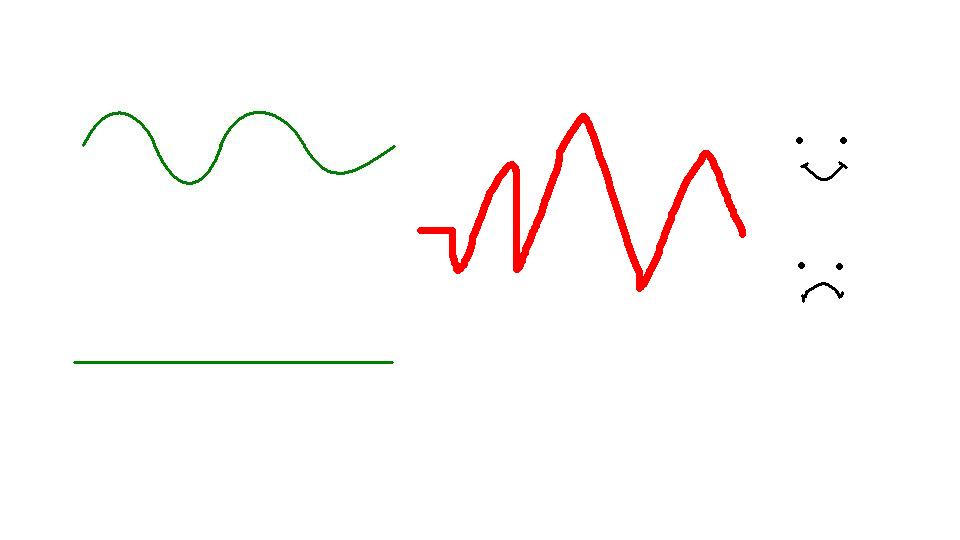
For me, Real-World Edge= Analytical Edge + Emotional Variance.

The EV is always negative, unless you're a robot...then it can be as high as zero. Cue shitty paint drawing for explanation:

Dampen your own mood swings and keep your edge's heart beating!
Everything in the world revolves around cycles and waves. I see the working of an edge as a wave not unlike those you find in the sea or on an ECG. Even the spinning of the Earth can be tied into the Sine Wave. In short, if it's pulsing, it's good. If it's flat, it's dead!

So most/all of us have some degree of AE in the beginning similar to the first green , semi-sine, wave in the above doodle. Then we get in the way with our huge EV, crashing into our AE.... neutralizing it with much the same effect as those anti-noise earphones people use on planes.

The result is a dead edge.

It's my opinion that the easier (much easier!) path to trading success is to try to get that red line as close to flat as possible rather than look to find/create a sharper edge in the market.

Sunday, January 20, 2013

Reduction = Greater Efficiency + Focus

I just recently read a fantastic post by TraderRach and it got me thinking....

Years ago, I was a Chef in some of London's best establishments.

We had a lot to do in relatively little time... and it had to be done to a certain standard. The pressure to perform led to some great revelations. Suddenly, I found myself studying things which may have seemed irrelevant to some but really improved the bottom-line in terms of performance, freeing up time and energy which could then be spent in more productive ways.

Wasted trips to the walk-in fridge, to the rubbish bins...unnecessary movements to get to things which could be stored in a more accessible way etc etc. I soon found myself implementing various techniques- strategies if you will- in order to streamline the task at hand.

I later realized that my approach in a commercial kitchen was the main reason for my initial success in the markets.

It's not so much what you are doing as it is how you are doing it. It's all too easy to brush off certain procedures as being unimportant to the point where some people don't even consider them. But those are likely the very things you should be focusing on. Strive to do simple in military fashion rather than fancy done in anything less than.

Jiro is a fine example of this concept.

Reduce. Fewer markets, fewer indicators (which has never been an issue for me personally)

I used to have alarms until I realized that they, well, alarmed me and made me feel as if I had to act straight away or, strangely, should wait for confirmation. I used to have a sound for an order filled until I realized that it heightened my sense of doom (for stops) or attachment to a position (for entries). The same for trendlines and the "position indicator" on IB's TWS. They all encourage you to focus on where you are in relation to the market or what you think the market's doing rather than keeping you inline with what is actually happening.

Fewer moving parts with more attention to detail given to each piece is the way forward for me.

Friday, December 21, 2012

Celebratory Video Review(s)!

We're not dead (yay!).....

Friday 21st December 2012

.....so I'm taking a leap of faith and posting one (or two) of the "diaryvids" that I record as part of my personal record keeping.

As mentioned in the above video's description, they aren't made for public consumption. The audience is usually limited to me and my girlfriend (poor thing!) and, as such, they are rough around the edges...but I'm sharing anyway...

EDIT: Second part of the week's review:-

Week Review (Wc 16th December 2012)Pt2

Sunday, December 16, 2012

What I've Learned- Month And Dataset Review.


 First thing to note is that there is an edge, as the pip-count, after spread (half of the costs incurred when trading at this size), is very much positive. Unfortunately those pips haven't quite covered commissions hence the negative result. This has pretty much been the case with my trading for the last three years.

In September's "Trading Without A Compass" post I referenced an idea that has plagued my trading for a long time- The "Profit Ceiling". I am lucky/skilled/aware enough to know when it has been reached but, despite that knowledge, this is how the four weeks panned out:


I know exactly why I traded past the ceiling on every occasion. First off, I refuse to accept that it exists (more on that in the 3rd and final reason). Secondly, I want/expect to be able to trade my method continuously. After all, if it worked to the ceiling, it should work past it right?

Wrong.

Integral to the method is my discretion. So, when I feel as if the ceiling has been hit- it has. Even if it is a self-fulfilling prophecy, it can't be ignored.

The other reason is not easy to write here, but I'm going to say it anyway.

I'm addicted to trading.

Somewhere along the journey, it stopped being about profit and became more about the challenge. Going up against the market is ALWAYS a bad idea. If I had simply stopped trading when I felt like I had bumped into this "Profit Ceiling", I'd have found myself up some $550 on the month, even with the >4R loss that occurred due to a gap against me.

This idea of going up against the market is ludicrous. Most people learn how to create an edge for themselves within a couple weeks/months of careful study of a chart. After that, it's an exercise in self control and a desire for long term results over short term thrill.

A bit disappointed in the lack of participation in this blog (not one vote on the last poll!!!) so may cut back drastically/stop as it's a waste of my time otherwise. I already keep detailed data in the form of spreadsheets (as seen here) and video diaries so only really here to ignite discussion on the real challenge that is trading...

....it's NEVER the market's fault. Long-term results are all our own doing. :)


Saturday, November 17, 2012

Day's Anatomy- 16th November 2012...Readers' Poll 2!

Notice the direction of ALL the trades.
I suddenly started thinking about this post that I made years ago. 2) & 4) in particular.

It (No 4 from the above link) was the same when I started this blog. That is likely why I deliberately started avoiding tracking day-to-day progress in the first place.


Do you see the obvious clues?

In the above equity chart:

Light Green
   = Paper Trading.
Dark Green
   = Live Trading.
Blue
    = Daily Blogging.
So I'm giving myself at least a month of trades without a single blog post (I'll continue updating my records though..spreadsheet, videos etc). Then I'll probably be back to report on any changes.

So I've either succumbed to the pressure of real-money trading or, coincidentally, what I'm doing stopped working when I made the switch. Or maybe it's just a draw down in an otherwise profitable approach.

What do you think?? (see poll on the right of the blog)

Back in a month!

Thursday, November 15, 2012

Day's Anatomy- 15th November 2012

Knew this type of day was round the corner...

I've seen this pattern in my trading many times. Too many almost-successes (several trades that were good for target, close-to-execution trades that easily returned target-making pip amounts etc etc). Then you just let go....like sellers giving up at the beginning of a break out.

Luckily, I use stops, both trade and daily.

Was one step behind PA today. Would have been a losing day anyway.

Wednesday, November 14, 2012

Day's Anatomy- 14th November 2012

Pretty good day it terms of behaviour. No knee-jerk reactions.

Still struggling with the discretion involved...had I have taken every potential trade candidate, I would have had lots of opportunity for winning trades of varying degree, along with 2-3 extra losers. Statistically that is the thing to do..goes without saying.

Psychologically it isn't. At least not for where I am with my trading. Taking trades, win, lose or draw, uses up emotional capital, of which I have little! Managing trades is my stronger suit. So I'm aiming to do more with less...

Day's Anatomy- 13th November 2012- Changing Your "Reality".

Today, 5 of the 6 trades taken were good, well thought out trade. 3 losers of varying size and a couple decent winners. The bad one was the third loser/4th trade.

Missed the xxx24 @ the high of day by a hair. That would've got me to my target for the day. Took the next trade long, a loser. No problem. Then, rather than go with the other side of the trade- despite the 1 min wicks against my prior long ZoA i.e S becomes R- I tried to almost bully the market to go my way by moving the trendline (ZoA) slightly lower down to allow me to take the long again..."just in case I was off the first time".

I'd say the market beat me but the truth is (and always will be) that I beat myself.


That was my momentary loss of control/calm today. I attribute it to the near miss and the fear of losing in the direction that was supposed to have brought me to target. Irrational, illogical....and completely human.

Came back with a fresh logical approach and reversed the damage for basically a scratch day.

It's not that there is any one way to read the market, but you certainly can't modify reality of your strategy to try to escape losses, maintain control or whatever it is that motivates you to mess with what works. You have to know that you will take losses (the "good" ones) but, moreover, you have to want to take losses as part of a profitable trading routine.

Avoiding those losses means you are no longer trading your system, which means random trading. Random trading means losses equal to trading costs over the long term.

Tuesday, November 13, 2012

Day's Anatomy- 12th November 2012

I tried, but can't find an unforced error in my trading today. Yippee!

The eagle-eyed may notice a bunch of other trade markers on the chart other than the ones I've marked up. Those aren't my trades ;) More about that in a future post!

As Scalpy says,  

"There are four types of trades. Good winners, bad winners, good losers and bad losers."

Today, I only have the good variety of winners and losers on my chart so, as such, can't really add much in terms of commentary here.

What I can say is that the three days since switching back to SIM have, magically, been net positive overall. I guess I should be happy...*sigh*

As I've said before, the passing grade is now higher than before. I hope this will be enough to bolster my confidence to the extent that there is little/no difference between my SIM discretion and Live account discretion.

It's funny, as a youngster, I always used to wonder why sports people sometimes had such difficulty bridging the gap between practice performance and match performance. Confidence and Faith...