Saturday, February 21, 2015

Combine End Of Week (EOW) Review 1.


Blue and Red values are winning and losing days respectively.
What I'm pleased with this week is my consistency of approach towards my interaction with the market. I chose how much I was prepared to lose and stuck to it, even if I used to find it difficult to "give up" (We have to learn to be good losers in order to win over the long haul). I knew I wanted to have bigger winning days than losing ones and so I made that possible by controlling the downside...

I see a few areas for improvement. In order of importance:-

1) Emotional Variance- As mentioned in this post, this is, in my opinion, the most detrimental threat to anyone's profitability. Tuesday's mild euphoria followed by extreme emotional fatigue the following day meant a lapse in my ability to wait. If I had done so, I would have had the opportunity of up to 5 points of profit rather than the -1.5 points that I ended up with.

Action Plan: I have enough awareness of self to catch this scenario as it's unfolding. I will be in bed earlier than midnight on those winning days that trigger such a reaction. No bed before midnight, no trading the next day.

2) Run Winners, Cut Losers- This can be intra-trade, trades relative to other trades or on a collection of trades that make up a period of time, such as a day. I did a good job with the first two but not with Tuesday (took one-and-done) and Friday's trade (lowered contract size) which inevitably capped the week. This was done on purpose but, as I said, it won't do long-term.

To do this requires trust. Trust that pushing when already up will result in more over the long-term. Trust that, as much as you think you can fight, giving in too soon will save you in the long run. We have to forget those odd occasions when we pushed and gave back gains or when we fought our way back from huge drawdown.

Action Plan: Risk at least one more trade (full-size) when I'm up as much as I'm prepared to be down on any given day. Know that, sometimes, this is going to mean taking a decent winning day and turning it in to a smaller one in order to reach those larger-than-average-losing-day winning days. Example: If I'm only prepared to lose $336 in any given day, then take that one extra trade when up $336 on any given day.

It's also interesting to note that, just by moving from 5 contracts to 1 on that last trade, I cut the weeks' expectancy by just over 10% - E= 0.1013 missing from what would have been 0.2767.

In a nutshell- Go to bed and push when you're winning.


Friday, February 20, 2015

Combine- Day 4.


I was particularly pleased with the first trade today. My "Daily Goal"- one of 5 daily notes that you are encouraged to keep in the community journal at TST- was " Wait, read and react with no thought of where I am for the day (until daily tgt or stp)" 5.25 pts/3 pts respectively. This was almost achieved today.

 I walked my way through the pre-trade analysis, analysing out loud, from 14:13 CET until the trigger at 14:43 and then continued the analysis through the trade with no noticeable change in pace or attitude. It helped that I had my partner with me but the whole event, from the stalking to the entry, management and eventual exit, seemed effortless.

Of course, when it was time to put on a second trade 3.5 hours later, the ole brain started whizzing through what a losing trade would mean in terms of the weeks' result and the TST stats- both of which mean very little in the grand scheme of things.

So that second trade's MFE was 3 pts. The earlier win was 2.5 pts...but I decided to put on just the 1 lot- down from the usual 5- to protect the day and week. Long-term, this won't do...but I'm treating this week as acclimatisation, so I'm happy to pay for that in lost E this time.

Later/tomorrow, I'll be posting the uploaded stats from my own spreadsheet and looking at what I learned this week by going over each trade, and the accompanying emotions, with a fine-toothed comb. Then I'll see how I might use that to move towards sharpening the edge for next week and beyond.

Thursday, February 19, 2015

Combine- Day 3.


Nothing to report here...only the feeling that I'm trading a losing approach simply because the first three trades have resulted in a net loss. Do the same thing tomorrow. Look at the result after 10 well managed trades in a row.

Wednesday, February 18, 2015

Combine- Day 2.


I know these days well.

It goes something like this. Happy with my actions on the prior day leads to euphoria. I can't get to sleep until late as I feverishly imagine what it'd be like to be completely location and time independent. I'm talking calculating how much it costs to live in Medellin, who I'd pay tax to if I was a digital nomad...the works. When I do eventually get to sleep, I don't rest well and my eyes are wide open by the crack of dawn.

One of two things then happens:

1) God complex in tow, I bend rules that served me well even if, in the moment, I'd swear that I didn't. It doesn't work out or, worse still, it does.

2) I become overly careful. This then leads to frustration which ultimately leads to 1). The amount of frustration is directly correlated with the amount of damage I end up doing.

In short, euphoria leads to emotional and physical exhaustion which then leads to decisions based on "then" ("it worked back then"= past or "If I get out now and it goes in favour, then I'll miss out on X"= future) rather than "now". "There" rather than "here". Gone unchecked, this can cause traders to doubt their edge, or abandon it entirely. All they needed to do was trust and stop trading so as to limit the damage. This is what I've done today.

A whole host of emotions arise when you take this kind of action; "I could have made it back and then some" or "If I have true edge, I should just plug away and take more trades" but that's just our inherent faulty wiring that causes us to fight when we are losing and run with some gains when winning.

Continuing with 5 lots for now and back to waiting diligently, taking what the market has to offer and asking for no more.


Tuesday, February 17, 2015

"StoryBook" Trading Meets TopstepTrader's Continuous Combine!

At the request of this frequent blogger, and this not-so-frequent one (!), I've decided to document my journey in the TopstepTrader Combine.

I'm trading the $100K account. Here are the account parameters and Combine rules:


The profit target is $6K. Past performance would suggest an ETA of 20-40 trading days. This is the result of Day 1:


A bit of background info: blue rectangles = MR, Blue triangles = PF, Arcs = C2N and Yellow ellipses = App....all colours refer to the background of the shape.


EDIT: I've been made aware that the charts are a bit small. This 5-min chart and this 15-sec chart should be clearer.

I opened the Combine on the 12th of February 2015, but due to US holidays and just generally getting myself set up (I subscribe to Continuum data but the program only works with Rithmic etc) I was only able to get started today.

The green triangle on the 5-min chart depicts the trade I decided to let go. My plan was to trade half-size (I intend to start trading 10 lots shortly) with a one-and-done approach, win, lose or draw. I bailed 3-4 ticks before the target because:

1) Moves tend to be quicker and more volatile during the late EST morning/early EST afternoon in the NQ as compared to pre-market (when I sometimes attempt to catch bigger moves).

2) It put in wicks a hair above the 1st target of the pattern.

My aim is to document everything here, but, should it start to take my focus away from the task at hand, I will scale back/stop the blogging and just continue with my usual record-keeping.

Monday, October 13, 2014

Trade Room And "StoryBook" Trading Course.

For much the same reasons as the last time I did something like this, the Only The Momo trade room is back! Visitors will be able to listen in on my analysis- along with entries, stops and targets- as I attempt to take the trades myself. See the penultimate paragraph of this post and my recent Twitter posts if you're wondering why I say "attempt"...

I'm working on becoming a trader. But what I already am is a great analyst.

To understand why I'm making such a bold statement (along with what I think is a fantastic monthly return for only an hour's trading per day), stop by between the hours of 19:00-20:15 CET/ 13:00-14:15 ET and judge for yourself :).

P.S.    I'm in the process of creating video lessons for a comprehensive course detailing every aspect of the methodology in addition to the many psychological pitfalls and money management strategies. It will be available through this website....watch this space!

P.P.S   The first videos are up! Check out the "Education" tab at the top of the blog for a short description about each of them.

Friday, July 25, 2014

Back...

.....but only long enough to promote talk about my latest challenge.

As I hinted at before disappearing, it was time for a more holistic approach to life/trading success.

In the last 12 months I've radically changed my lifestyle: Diet, Meditation and regular exercise (Coming from an athletic background, I hadn't noticed that I was slowly...very
slowly...becoming rather sedentary) along with making sleep a priority again.

 So now that I am no longer addicted to trading (I regularly trade just an hour a day and actually have dinner with my family again. Everyday. Without fail! Something I hadn't done for years before..) and have smoothed out the Emotional Variance to a large extent , I feel as if I have what it takes to accomplish the much touted sign of true competence in trading:

I'm going to make 100% on my account risking 1.7% per trade.

Expectancy suggests that should take until late Nov/early Dec, but I'm targeting the end of the year. If it takes longer, so be it. Less time would be icing on the cake...

My progress can be followed on Twitter and also on YouTube....I'll share as much as I can without distracting myself from the task at hand. I've already noticed a difference the other day when I flipped Camtasia on to capture the live trading, so I'm not making any promises where videos are concerned!!!

Links at the top right hand side of the blog- See you there!


Wednesday, June 12, 2013

The End.

Just moved from a rather modest flat to a not-so-modest house. Now I have the office in the loft/attic (or "mansarda" as they say here in Italy) that I've always dreamed of AND space (3 floors down!) to practice my hobby of the last 15 years and counting, as well as just workout in general. 

It's a beautiful house- it has 4 balconies (of varying size), 3 bedrooms, the loft, 4 bathrooms (!!), a tavern with a fireplace and a pizza oven, kitchen and living room as well as a garage.

I got this by learning to trade....but not from trading profits ;). The secret is hidden within the 218 posts of this blog.

That being said, there's not much more to add. I'd only be delivering the same content in a different way which is a poor use of my time.

So, in the spirit of reduction:

- Cheap clients rejected...? Check!
- Time-wasting satellite television subscription cancelled...? Check!
- Reduced time on the Net...? Check!
- Blog concluded, only to be reignited as a teaching tool should there be demand...? CHECK!

Good Luck for your life and trading. :)

Wednesday, May 1, 2013

The Mighty Momo! Pt 2- Wood For The Trees.

Below is a recent example of the pattern in play. This time, I've included volume to show how that works with the progressively smaller magnitude waves of selling (See "The Mighty Momo!" for the original mark-up, which was a short)...

Picking out the mass of volume is the idea.
The lower volume on each successive leg of selling compared to the prior one is a sign that the sellers are losing conviction. Add in the "Golden Mean Extension"- which isn't always this clean- and you have something which gives a "trade-able bounce" (subjective: refer to the above link for my thoughts on that) around 80% of the time.

So, at first glance, it looks like volume isn't favourable for the above setup. But that's a case of missing the wood for the trees- just have a look at the body of volume. They do provide the decline we're looking for in order to take a trade. The "trees" do provide us with evidence of short-term trend exhaustion and, as such, give a heads-up as to where you'll find the pivot. Again this is not an exact science and you need to look at recent PA to determine how volume is signalling turns relative to price (at the exact pivots, slightly above/below etc).

Incidentally, I've noticed that the GME tends to also be present in terms of time. IB's charting package doesn't provide that tool, but it's quick to do with a calculator plus the approximate times the lows/highs occurred.

Saturday, April 13, 2013

The Three Types Of "Now".

What is "Now"?

The following passage is taken from The TAD principle. I first heard about this concept through TraderX's site some time ago. I thoroughly recommend it.

"The past and future don't exist. Your mind works hard to convince you that they do, but in reality the past and the future are simply thoughts happening right now, in the present moment.

Does that mean you shouldn't enjoy memories of things that happened in your past? Not necessarily, but there is a fine line between enjoying a memory and rejecting the present moment in favor of clinging to times gone by:

"If only things could be that way again."
"I wish we could go back to those days."
"I was much happier then."

It is easy to turn what you label a "positive" memory into something that gives rise to regret, sadness, or bitterness. Such is the reality of past and future thoughts. When you project into the future, you create stress, anxiety, and worry, as well as fears over what "might happen". And reliving the past creates feelings of guilt and resentment, as well as non-forgiveness of others and yourself.

When we are pulled out of the present moment, we create suffering for ourselves. It's ironic, because you are only here now - it is the only moment you ever have. But, if you aren't mindful of your thoughts, you will spend "now" lost in stories of the past and the future."


We spend so much time thinking about the past (a "now" which we have already experienced) and the future (a "now" which we have yet to experience) that we get sidetracked from thinking about the true now.

How many times have you practiced a conversation that you expect to have in the future? Or tried to mentally run through what you did wrong in a past "now" so that you'll be better prepared "next time"? (By the way, it'll NEVER be the way you imagined it!)

Now is so infinitely small that it can't be measured but, paradoxically, it draws itself out in to infinity. 

Mastering the art of doing the best we can with the present moment will, by default, take care of the future we worry so much about because our now will eventually be that future. Likewise, it'll take care of any "past regrets of the future" because your futures' past will have once been the present...and you're always taking care of that.

Tuesday, April 2, 2013

The Mighty Momo!

This pattern has formed the basis of the vast majority of trades that I've taken over the last 5 years and counting. Whether it be a derivative of the pattern (Pattern Failure or the Appendix) or the pattern itself...

Saying a pattern is "profitable" is, in my mind, completely ludicrous. Simply because it depends on too many factors. The pattern itself is almost irrelevant (but, paradoxically, extremely important in that it has to offer a tiny edge)...it's the framework - both systematic and mental - built around it that's (hopefully!) going to make it profitable for you.

Some of the answers to the many questions which have to be tackled when using this approach have their foundation built upon market dynamics. Some are based on the trader him/herself. Others are a combination of both:-

* What Time frame? The considerations are very different when used intra-day as opposed to swing trading...
* What high do you choose as your anchor? Why?
* How do you trade out of the third high? Reversal candlestick trigger? Channel break? Or do you just trade the level without "confirmation"
* How will the above alter your R:R? Will it alter your WR?? (See below)
* Are you using a fixed stop or a technical stop?
* How accurately can you pick off the highs? *Are you playing the statistical game or analytical one? That is, take profits that work based on R:R and WR or try to get to S/R / target levels based on...whatever?

There are probably more, but it's late and I want cereal!


Monday, February 11, 2013

SPLURGE!

As first alluded to in This post, "Fear Of The Futures" and, most recently, categorically confirmed in "Trading Without A Compass- Revisiting Past Posts." , I fear the loss of accrued "gains" (success, progress, money etc) and so tend to self-destruct by changing the very mechanism that got me the success in the first place in a futile attempt to exert control on the situation.

It always ends in the same way.

So, as proposed in the above and various posts over the last few years (Yikes! It's been that long?!), I've "locked in the success"/"reset the account" etc by withdrawing last weeks' profits and squandering spending them on a bunch of DVDs that I've been meaning to get to add to our collection.

Here are a few of the 18 titles;

My intention is to use any potential profits as a supplement to my current income and/or grow my account (the latter would be a challenge due to my difficulty in building on past successes- any solutions would likely be documented here in a future post) not to be used as pocket money, as is the case with this week.

 I felt this kind of purchase was necessary to highlight the fact that it was made using the fruits of my work in the markets. Those profits will be "secure" in a very visible way here at home which will leave me free to repeat the process with an account that has been "reset". In a cognitively-biased way of course!


Wednesday, February 6, 2013

Sandcastles- Shifting Thoughts And Supports

"sand·cas·tle  
n.
1. A castle-like structure built of wet sand, as by children at a beach.
2. Something that lacks substance or significance."
Trying to out-think your own logic is stupid on so many levels. 
Firstly, you can't collect any meaningful data about your interaction with the market if you are a neurotic, strategy-changing mess. So stop doing everything and start doing something consistently! Secondly, how can we learn to trust ourselves if we can't define what we are by what we do if we don't actually do any one thing?? 
Slave to a combination of Outcome Bias and Loss Aversion, we have the urge to circumnavigate our own strategies (!!!) in an attempt to avoid inevitable losses- or at least exert some control (there's that word again!) over when they do or do not occur...all we really do is miss the real chance to learn something about our long-term relationship with the market.

If, by your analysis, a pattern/setup was "strong" or "supposed to work", shouldn't that then offer a very profitable trade in the opposite direction of the failed pattern/setup especially if there is some sign of rejection on the other side of the stop zone...??
If it doesn't, then you're likely building on sand, at least on this occasion. The crucial thing is to let the market tell you that with a "failed trade" (Not necessarily an unprofitable trade...) rather than doubting your own train of thought...a sure sign of lack of trust and/or need for control. You can't modify what doesn't exist in the first place.

Incidentally, I'm back on the live account with half-size which has made all the difference. If one is having difficulty bringing practice performance into the live arena, I'd highly recommend trying to trade a part of whatever size was used in SIM forward-testing when attempting to go live.
Feels like SIM...but with tangible benefits :).

Tuesday, January 29, 2013

You And Your Edge.

First off, let me say that I strongly believe most traders (all?) have an Analytical Edge in the market to some degree...the problem is, that's not nearly enough.

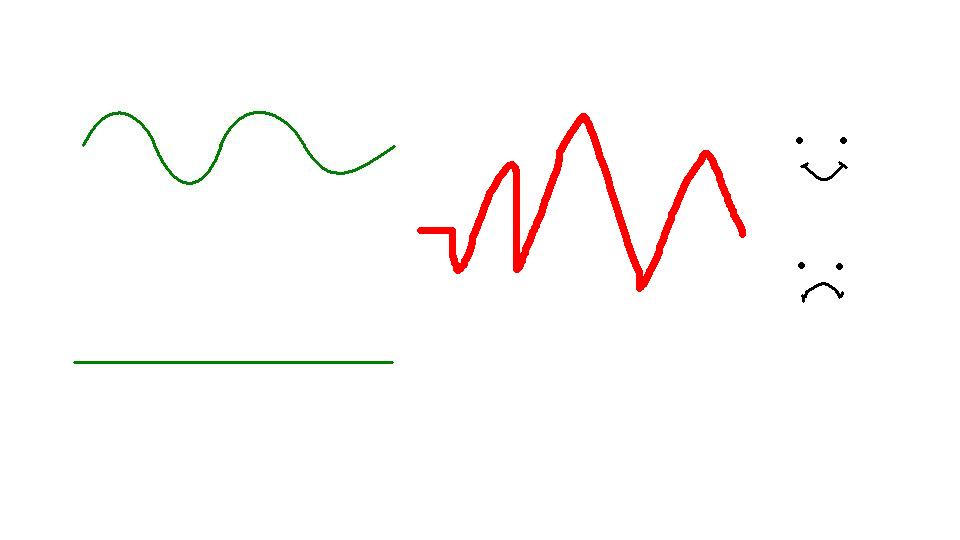
For me, Real-World Edge= Analytical Edge + Emotional Variance.

The EV is always negative, unless you're a robot...then it can be as high as zero. Cue shitty paint drawing for explanation:

Dampen your own mood swings and keep your edge's heart beating!
Everything in the world revolves around cycles and waves. I see the working of an edge as a wave not unlike those you find in the sea or on an ECG. Even the spinning of the Earth can be tied into the Sine Wave. In short, if it's pulsing, it's good. If it's flat, it's dead!

So most/all of us have some degree of AE in the beginning similar to the first green , semi-sine, wave in the above doodle. Then we get in the way with our huge EV, crashing into our AE.... neutralizing it with much the same effect as those anti-noise earphones people use on planes.

The result is a dead edge.

It's my opinion that the easier (much easier!) path to trading success is to try to get that red line as close to flat as possible rather than look to find/create a sharper edge in the market.

Sunday, January 20, 2013

Reduction = Greater Efficiency + Focus

I just recently read a fantastic post by TraderRach and it got me thinking....

Years ago, I was a Chef in some of London's best establishments.

We had a lot to do in relatively little time... and it had to be done to a certain standard. The pressure to perform led to some great revelations. Suddenly, I found myself studying things which may have seemed irrelevant to some but really improved the bottom-line in terms of performance, freeing up time and energy which could then be spent in more productive ways.

Wasted trips to the walk-in fridge, to the rubbish bins...unnecessary movements to get to things which could be stored in a more accessible way etc etc. I soon found myself implementing various techniques- strategies if you will- in order to streamline the task at hand.

I later realized that my approach in a commercial kitchen was the main reason for my initial success in the markets.

It's not so much what you are doing as it is how you are doing it. It's all too easy to brush off certain procedures as being unimportant to the point where some people don't even consider them. But those are likely the very things you should be focusing on. Strive to do simple in military fashion rather than fancy done in anything less than.

Jiro is a fine example of this concept.

Reduce. Fewer markets, fewer indicators (which has never been an issue for me personally)

I used to have alarms until I realized that they, well, alarmed me and made me feel as if I had to act straight away or, strangely, should wait for confirmation. I used to have a sound for an order filled until I realized that it heightened my sense of doom (for stops) or attachment to a position (for entries). The same for trendlines and the "position indicator" on IB's TWS. They all encourage you to focus on where you are in relation to the market or what you think the market's doing rather than keeping you inline with what is actually happening.

Fewer moving parts with more attention to detail given to each piece is the way forward for me.